Altitude Velocity Shifts: How Elevation Reshapes Scoring Patterns in Football and Tennis Markets
Written by Alex Schmidt · Aug 26, 2026

Altitude Velocity Shifts: How Elevation Reshapes Scoring Patterns in Football and Tennis Markets
High-elevation venues create measurable changes in ball behavior because thinner air reduces drag and alters lift forces, which in turn affects distance, speed, and bounce across both football and tennis. Researchers from multiple institutions have documented these physical shifts through controlled testing and match data analysis, revealing consistent patterns that influence total goals, set lengths, and point distributions. Observers note that football matches staged above 2,000 meters often produce elevated shot volumes and longer passes, while tennis encounters at similar heights show faster serve speeds and higher bounce trajectories that compress rally durations.
Physical Mechanisms Driving Velocity Changes
Air density drops roughly 12 percent at 1,500 meters and continues to decline at higher altitudes, allowing a football to travel farther when struck with the same force; the same principle applies to tennis balls, which experience less resistance during flight and rebound higher off court surfaces. Studies conducted by sports science teams at the University of Colorado have quantified these effects through wind-tunnel experiments and on-field tracking, showing average football pass distances increase by 4 to 7 percent while tennis serve speeds rise between 3 and 5 percent at comparable elevations. These adjustments occur without changes in player technique, creating predictable scoring variances that betting markets must incorporate when setting lines for total goals, total points, and over-under markets.
Football Scoring Dynamics at Elevation
Venues such as Estadio Hernando Siles in La Paz and Estadio Azteca in Mexico City demonstrate repeatable trends where home sides record higher goal tallies during league and international fixtures. Match data compiled across South American and CONCACAF competitions indicates average goals per game rise 0.4 to 0.8 above sea-level baselines, with away teams struggling to maintain defensive structures because clearance distances extend and goalkeeper reaction windows shorten. Teams that rely on high-pressing systems often see reduced effectiveness, whereas sides favoring long balls and crosses record improved conversion rates; these tendencies appear in both domestic leagues and qualification tournaments scheduled through 2026.
August 2026 fixtures in the Bolivian Primera División and Mexican Liga MX will again test these patterns as clubs prepare for matches at altitudes exceeding 3,000 meters. Pre-match preparation protocols now routinely include acclimatization periods and adjusted training regimens, yet statistical edges persist for teams familiar with local conditions. Betting exchanges adjust totals upward in these environments, with market liquidity concentrating on over-2.5 goals selections during the opening weeks of each season.
Tennis Performance Adjustments at Altitude
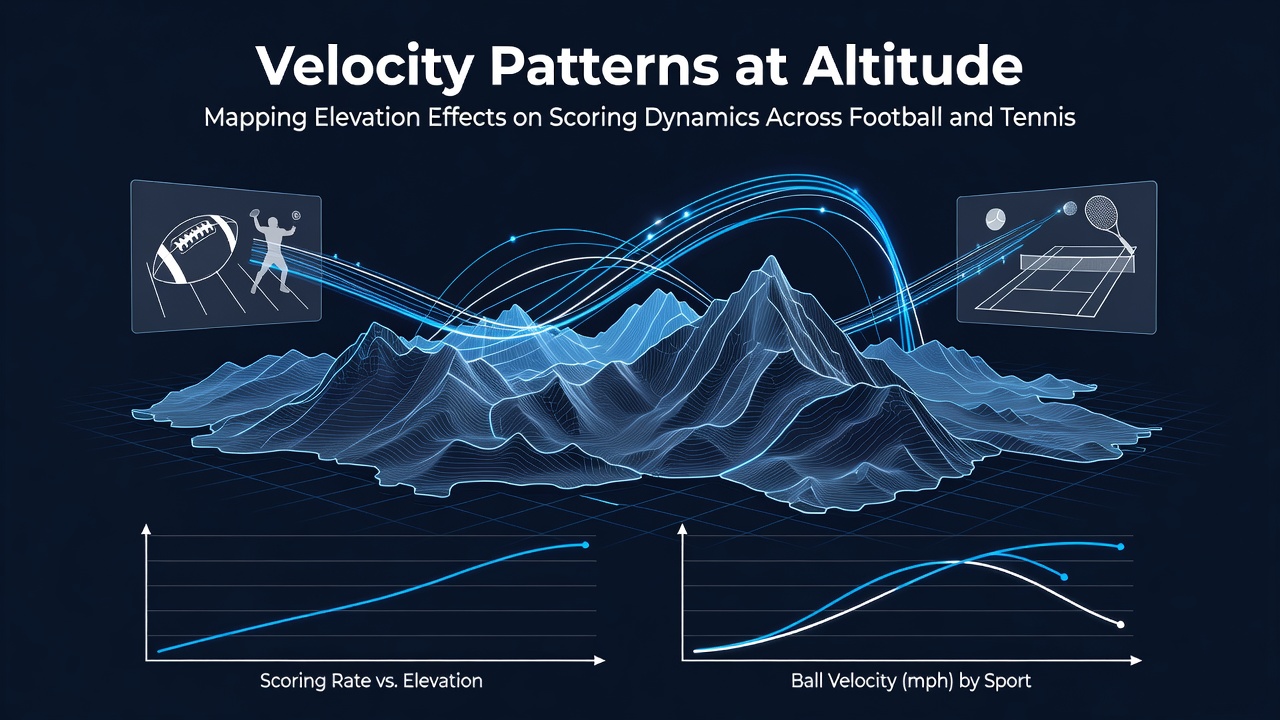
Tennis tournaments held in locations such as Denver and Bogotá produce shorter rallies and elevated ace percentages because reduced air resistance allows serves to retain velocity deeper into the court. Performance analytics from ATP and WTA events staged above 1,500 meters reveal first-serve win rates climbing 4 to 6 percentage points compared with low-altitude stops, while average rally lengths contract by one to two shots. These shifts influence game and set totals, prompting oddsmakers to recalibrate over-under thresholds for match points and total games. Return statistics also move measurably, with players who rely on heavy topspin experiencing diminished margin for error when the ball travels farther than anticipated.
Market Implications Across Both Sports
Betting operators incorporate elevation data into pre-match models because historical results show statistically significant deviations from sea-level averages. Football accumulator builders frequently target over totals when fixtures involve multiple high-altitude venues, whereas tennis markets see increased activity on game totals and player-specific serve metrics. Data from international federations and academic tracking projects confirm that these patterns remain stable across multiple seasons, allowing systematic approaches to line shopping and market timing. Observers tracking both sports simultaneously note occasional crossover opportunities where football goal trends and tennis game totals align during shared tournament windows.
Industry reports from organizations such as the International Tennis Federation and FIFA technical studies continue to supply updated datasets that refine these models. Those who monitor live odds observe that bookmakers widen or tighten lines within minutes of lineup announcements when altitude effects intersect with player fatigue or surface conditions. The result is a continuously evolving landscape where elevation serves as one measurable variable among many that shape final outcomes and market movements.
Conclusion
Elevation-driven velocity changes produce documented, repeatable impacts on scoring in football and tennis that extend directly into betting market structures. Continued collection of match data from high-altitude venues supplies ongoing calibration for predictive models, ensuring that totals and player props reflect physical realities rather than baseline assumptions. As schedules for 2026 advance, these elevation effects will remain a core input for analysts evaluating performance edges across both sports.